A buyer walks into a Business Bay sales office on a Thursday afternoon. She has never spoken to the agency before. She already knows which three developers she will consider, which two communities she has ruled out, and exactly why she is not buying off-plan this year.
She read no brochure. She attended no open house. Over two weeks she asked an AI assistant nine questions, and it answered every one of them.
Real estate digital marketing in Dubai used to begin when the enquiry landed. It now begins weeks earlier, inside an AI chat window you cannot see, in an answer you did not write. This article sets out the nine questions that answer gets assembled from, and what to publish so your brand sits inside it rather than outside it.
Your shortlist is built before the phone rings
Buyers have stopped typing keywords. They type sentences. Instead of “Dubai Marina 2 bed”, they ask whether Dubai Marina still makes sense for a first investment on a five-year hold. The assistant returns one synthesised answer with a short list of names attached, and a large share of those conversations end there. No portal visit. No click to your site.
That changes what you are competing for. You are no longer competing for a position on a results page. You are competing to be one of the three or four names the assistant mentions.
Here is the part most brokerages miss. AI systems do not weight all sources equally. Regulatory filings, primary transaction data, and established media sit at the top of the trust stack. Independent databases, industry analysis, and review platforms sit in the middle. Company websites, agency blogs, and influencer content sit at the bottom.
Read that again, because it has an uncomfortable implication. Your own website is one of the least trusted sources in the stack. It still matters, because it is where the facts get standardised. But it cannot be your only signal. If nothing above it in the trust hierarchy confirms what you say about yourself, the assistant has no reason to repeat your claim.
Dubai has an advantage here that most markets do not. The Dubai Land Department publishes transaction data that qualifies as primary data. Any brokerage willing to interpret that data publicly, consistently, and with a named expert attached is producing exactly the kind of signal AI systems reward.
How AI is Changing Customer Discovery
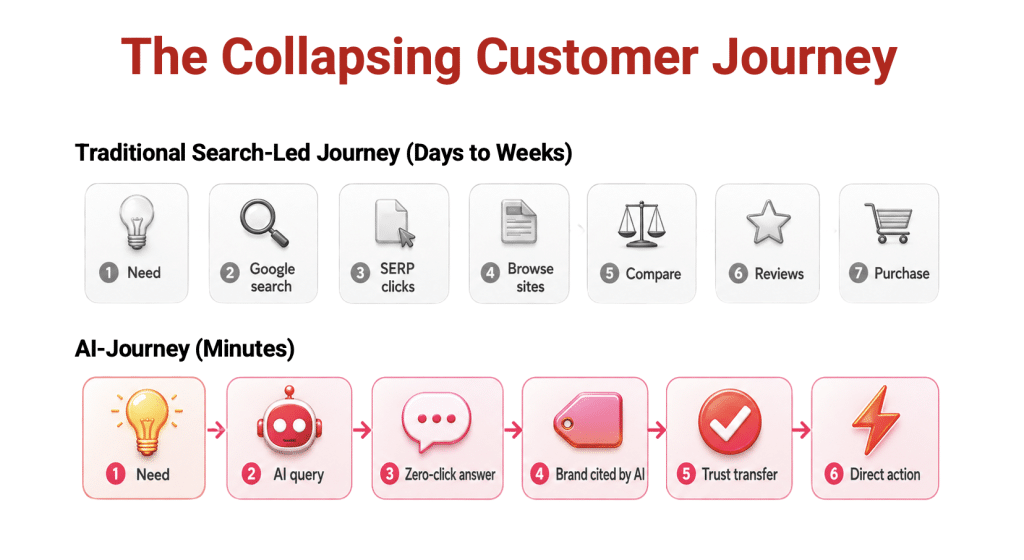
Property discovery used to run on browsing. A buyer opened Bayut, filtered by budget and bedrooms, scrolled through forty listings, and formed an opinion over five or six sessions. That pattern is breaking. Buyers now describe their situation in a sentence and let an AI assistant do the filtering for them, and the answer that comes back is not a list of options. It is a recommendation, with three or four names attached and a reason for each.
By the time the enquiry reaches your inbox, the comparison stage is already over. The buyer has decided which developers she trusts, which communities she has ruled out, and whether off-plan fits her risk appetite, all from sources she did not choose and you may never have pitched.
This is the real change for real estate digital marketing in Dubai. Visibility is no longer about ranking above a competitor on a results page. It is about whether the systems assembling that recommendation can find enough credible, consistent evidence about your brand to include you in it, and most Dubai brokerages have built their entire marketing programme for a buyer who no longer shops that way.
The nine questions, and what to publish for each
These are the questions buyers now put to AI before they put them to you. Each one deserves a real asset on your site, and each one is a media pitch waiting to happen.
1. Should I buy now, or wait?
This is the timing question, and it is almost always the first. The buyer is not asking for a market forecast. She is asking whether waiting six months carries a cost or a saving.
Publish a quarterly market position piece with a clear point of view, signed by a named person with credentials. Include transaction volume, price movement by community, and handover pipeline. Update the same URL every quarter rather than publishing a new post each time. Consistency of source builds citation weight.
2. Which developers actually deliver?
Reputation, expressed as risk. Buyers want to know who hands over on schedule and who does not.
You cannot fake your way through this one, and you should not try. Build a developer delivery reference page with handover records, project completion history, and community performance. Attach evidence to every claim. This kind of page earns backlinks from forums and buyer communities, which sit above your blog in the trust hierarchy.
3. Which communities are safest for investment?
“Safe” means low downside, not low crime. The buyer is asking about liquidity, rental demand, and service charge exposure.
Write community-level investment profiles that include service charges per square foot, average days on market, and tenant demand patterns. Most agency area guides describe lifestyle and skip the numbers. The numbers are the reason the page gets cited.
4. Where is the rental yield strongest right now?
Yield is the most searched commercial question in UAE property, and it is also the most poorly answered. Most pages quote a citywide average that was accurate two years ago.
Publish a yield comparison you refresh on a fixed schedule, broken down by community and unit type, with gross and net figures. Show your calculation method. Showing your working is a trust signal for AI in the same way it is for a buyer.
5. What goes wrong when you buy off-plan?
Buyers ask AI the risk questions they are reluctant to ask a broker, because they assume the broker is incentivised to downplay them.
Answer them honestly. Escrow protections, payment plan structures, handover delay precedent, and what recourse actually exists. A brokerage that publishes the risks candidly gets recommended more often than one that publishes only upside, because the assistant is looking for balanced sources, not promotional ones.
6. Ready or off-plan, which suits my situation?
This is a decision framework question, not a preference question. The buyer wants a rule she can apply to herself.
Build a comparison asset that segments by buyer type. End user on a mortgage, investor on a five-year hold, and a buyer needing rental income from month one all get different answers. Structure it so each segment is a clearly labelled section that an assistant can lift cleanly.
7. Is a longer payment plan better than a lower price?
A genuine financial question that almost nobody in Dubai real estate digital marketing has answered properly in writing.
Run the numbers. Show a worked example in AED with two scenarios side by side, including the opportunity cost of the capital not paid up front. One worked example with real figures beats ten paragraphs of general guidance.
8. Which community suits my family?
Schools, commute time, healthcare access, and green space. This is where Google’s move to layer Gemini over Maps changes things, because the buyer may now ask that question inside Maps rather than inside a search box.
Your Google Business Profile, your review volume, and your location data become part of the answer. Clean them up. A brokerage with eleven reviews and an outdated address is invisible to a local discovery assistant no matter how good the website is.
9. Who should I trust to represent me?
The agency selection question, and the one you have least control over. It gets answered from reviews, media mentions, RERA registration, and third-party validation.
Get your broker profiles onto your site with credentials, transaction history, and specialisation. Then work on earning independent mentions. An influencer walkthrough builds attention. A quote in a credible business publication builds citation.
Nine questions, nine assets, one consistent signal
Publishing the nine assets is the easy half. Making them read as one coherent brand is the half that fails.
If your PR describes you as a trusted family community specialist, your listings describe the same stock as luxury investment, and your ads describe it as high yield, an AI system reads contradiction. Contradiction gets filtered out. Consistency gets recommended.
Three practical fixes:
Standardise your entities. Tower name, developer name, community name, price, size, and handover status must be worded identically on your website, on Bayut, on Property Finder, on Dubizzle, and in your sales material. Not similar. Identical. Machines match strings, and small variations fragment your authority across several partial records.
Mark it up. LocalBusiness schema for your office and specialisation areas, FAQPage schema for the nine questions above, Review schema for your ratings, and Organization schema tying your people to your brand. Google’s structured data documentation sets out the requirements. Without markup, an assistant has to guess what your content means, and guessing usually means skipping. If your site was built without it, this is a web development fix before it is a content fix.
Let paid do the research. Your search campaigns already tell you which of the nine questions your market actually clicks on and converts from. Feed that back into what you write next and what you pitch to media. That is what a properly run programmatic advertising programme should return alongside leads.
Find out what AI already says about you in fifteen minutes
Before you commission anything, run this yourself.
Open ChatGPT, Gemini, and Perplexity in three tabs. Type each of the nine questions as a buyer would phrase them, with Dubai or your community named. Then record three things for every answer.
Are you named at all? If yes, in what position, and is it a recommendation or a passing mention? And which sources did the assistant cite to reach that answer?
That third column is the valuable one. It is a list of the publications, portals, forums, and directories currently shaping your market’s perception, and it is your PR target list. Repeat the exercise with your two closest competitors and the gap becomes a plan.
Tools such as Ahrefs Brand Radar and Profound run this at scale across thousands of prompts. Start manually. Fifteen minutes will tell you whether you have a content problem, an authority problem, or both, and applied AI for business usually starts with exactly this kind of baseline.
How Fitch Technologies helps
We build the whole stack from one Dubai office, which matters here because the nine questions cut across disciplines. The schema and site structure sit with our development team. The content, entity consistency, and search architecture sit with our SEO team. The intent testing sits with paid. Arabic and English run in parallel rather than as an afterthought translation.
Most agencies hand you one piece of this. Our real estate digital marketing work connects the pieces, because a disconnected signal is the specific thing AI systems discard.
The shortlist forms without you
Your next buyer will form her shortlist before she ever fills in your form. That shortlist gets built from answers to nine predictable questions, and every one of those answers is being written right now, by systems drawing on sources you may not have thought about.
You cannot control the answer. You can control whether your brand is in the evidence behind it. Start with the nine questions. Publish real numbers, name your experts, keep your facts identical everywhere, and earn mentions from sources more credible than your own blog.